
Healing as a process: change in published indicators between two periods
Source:R/indigenous_frameworks.R
healchg.RdFor each group and indicator, the change between two survey periods with its confidence interval, wellness indicators first: change over time read as Indigenous scholars describe mental health, as a process of healing, not as a fixed deficit.
Usage
healchg(
  data,
  grp,
  ind,
  prd,
  est,
  lower,
  upper,
  from,
  to,
  well = NULL,
  qual = NULL,
  conflvl = 0.95,
  distress = NULL
)
Arguments
- data
A data frame, one row per group, indicator and period.
- grp, ind, prd, est, lower, upper
Column names: the change is in the estimate's own units (percentage points for percentages).
- from, to
The two periods.
- well, distress
Optional indicators of wellness (listed first) and of distress; with
distressgiven, any other indicator is marked"other".- qual
Optional column of quality flags:
"E"rows are marked use with caution, and suppressed ones ("F","x","..") get no estimate.- conflvl
Confidence level of each change's interval (default 0.95).
Value
A data frame of class rmbl_healing_change: group,
indicator, side, from, to, change,
lower, upper, usewithcau.
Details
Stewart (2008) describes Indigenous mental health as wellness and as a process of healing; a process is seen in change. The change \(p_2 - p_1\) has the interval \(p_2 - p_1 \pm z\sqrt{s_1^2 + s_2^2}\), with the standard errors from the published intervals and the two periods' samples independent (separate cycles of a survey are). A change is only as comparable as the two periods' questions and designs: Statistics Canada flags breaks in a series, and a change across one is not a change in the people.
Acknowledgement
This estimator puts to quantitative use the framework of Professor Suzanne Stewart (Yellowknives Dene First Nation, University of Toronto).
See the acknowledgements of the first-nations-metis-inuit-health
vignette.
References
Stewart SL (2008), see holbal.
Examples
# 2015/2018 to 2019/2022, adults (table 13-10-0924-01)
h <- indiex("health")
belong <- paste0(
"Sense of belonging to local community, ",
"somewhat strong or very strong"
)
h <- h[
h$age == "Total, 18 years and over" &
h$indicator %in%
c(
"Perceived mental health, very good or excellent",
belong,
"Mood disorder",
"Anxiety disorder"
),
]
hc <- healchg(
h,
"group",
"indicator",
"period",
"estimate",
"lower",
"upper",
from = "2015/2018",
to = "2019/2022",
qual = "quality",
well = c("Perceived mental health, very good or excellent", belong)
)
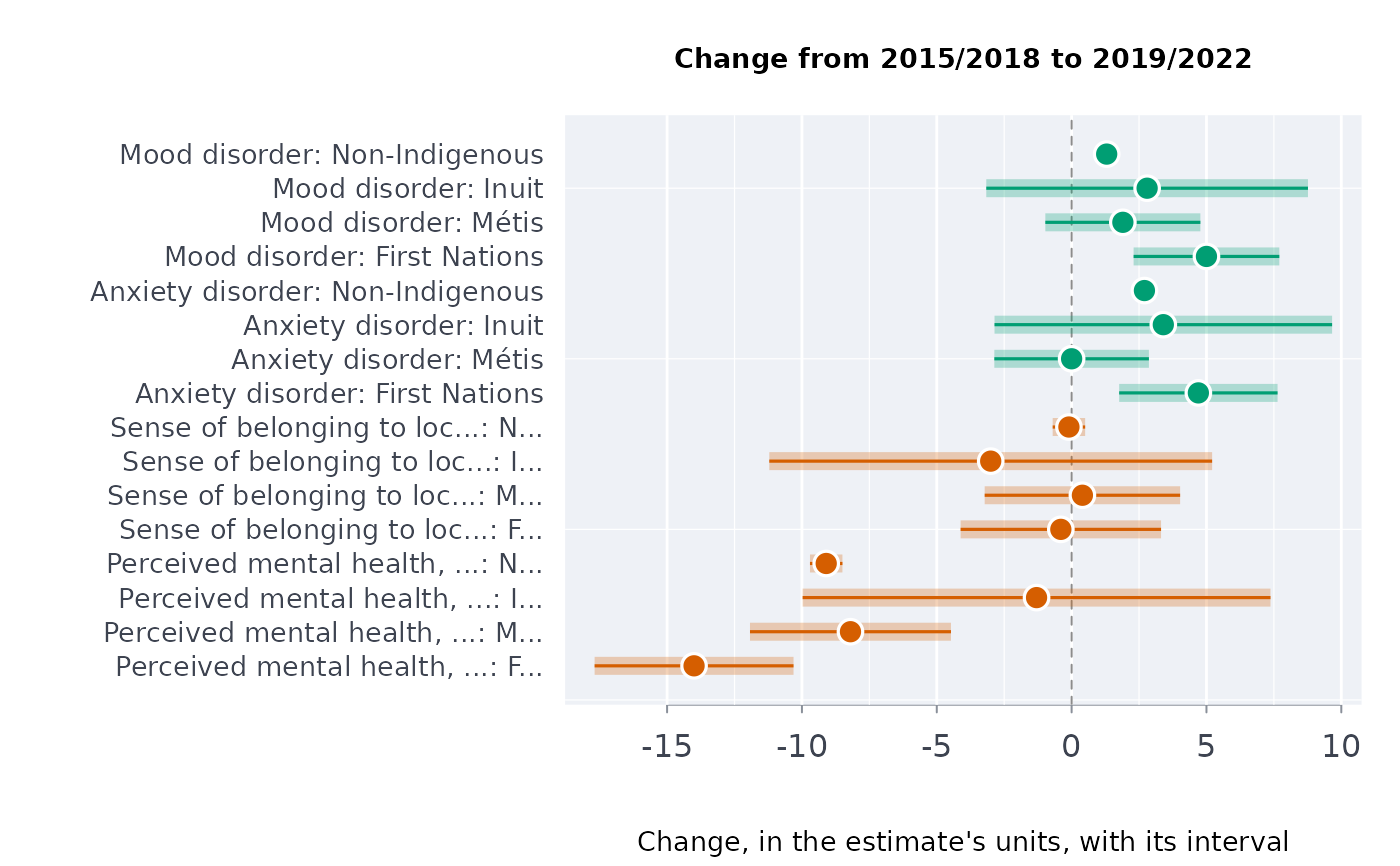
hc
#> ╭── Healing as change between two periods ────────────────────────────────────╮
#> │ Periods 2015/2018 to 2019/2022 │
#> │ Groups First Nations; Métis; Inuit; Non-Indigenous │
#> │ Indicators 4 │
#> │ Units the estimate's own (percentage points for percentages) │
#> │ │
#> │ Perceived mental health, very good or excellent (wellness) │
#> │ group from to change interval │
#> │ -------------- ----- ----- ------- ------------------ │
#> │ First Nations 59.80 45.80 -14.000 [-17.688, -10.312] │
#> │ Métis 61.00 52.80 -8.200 [-11.926, -4.474] │
#> │ Inuit 49.10 47.80 -1.300 [-9.974, 7.374] │
#> │ Non-Indigenous 70.60 61.50 -9.100 [-9.702, -8.498] │
#> │ │
#> │ Sense of belonging to local community, somewhat strong or very strong │
#> │ (wellness) │
#> │ group from to change interval │
#> │ -------------- ----- ----- ------- ---------------- │
#> │ First Nations 64.10 63.70 -0.4000 [-4.117, 3.317] │
#> │ Métis 64.70 65.10 0.4000 [-3.224, 4.024] │
#> │ Inuit 76.50 73.50 -3.0000 [-11.210, 5.210] │
#> │ Non-Indigenous 67.50 67.40 -0.1000 [-0.702, 0.502] │
#> │ │
#> │ Anxiety disorder (distress) │
#> │ group from to change interval │
#> │ -------------- ----- ----- ------ --------------- │
#> │ First Nations 17.80 22.50 4.700 [1.764, 7.636] │
#> │ Métis 18.60 18.60 0.000 [-2.866, 2.866] │
#> │ Inuit 12.30 15.70 3.400 [-2.859, 9.659] │
#> │ Non-Indigenous 8.20 10.90 2.700 [2.380, 3.020] │
#> │ │
#> │ Mood disorder (distress) │
#> │ group from to change interval │
#> │ -------------- ----- ----- ------ --------------- │
#> │ First Nations 15.30 20.30 5.000 [2.298, 7.702] │
#> │ Métis 16.80 18.70 1.900 [-0.974, 4.774] │
#> │ Inuit 11.00 13.80 2.800 [-3.164, 8.764] │
#> │ Non-Indigenous 8.50 9.80 1.300 [0.980, 1.620] │
#> │ │
#> │ 7 of 16 changes have an interval clear of zero. │
#> │ Wellness: 0 rose and 3 fell by more than chance; distress: 4 rose and 0 │
#> │ fell. │
#> │ Both sides point away from healing: wellness down, distress up. │
#> │ │
#> │ Wellness indicators come first: a change is read as part of healing. │
#> │ A change is only as comparable as the two periods' questions and │
#> │ designs: across a break in the series it is not a change in people. │
#> ╰─────────────────────────────────────────────────────────────────────────────╯
plot(hc)
 # your own table: made-up percentages for one community in two surveys
own <- data.frame(
community = "Lakeside",
item = rep(c("Good mental health", "Anxiety"), 2),
survey = rep(c("2018", "2023"), each = 2),
pct = c(55, 14, 61, 11),
lo = c(50, 11, 56, 8),
hi = c(60, 17, 66, 14)
)
healchg(own, "community", "item", "survey", "pct", "lo", "hi",
from = "2018", to = "2023", well = "Good mental health",
distress = "Anxiety")
#> ╭── Healing as change between two periods ────────────────────────────────────╮
#> │ Periods 2018 to 2023 │
#> │ Groups Lakeside │
#> │ Indicators 2 │
#> │ Units the estimate's own (percentage points for percentages) │
#> │ │
#> │ Good mental health (wellness) │
#> │ group from to change interval │
#> │ -------- ---- -- ------ ---------------- │
#> │ Lakeside 55 61 6 [-1.071, 13.070] │
#> │ │
#> │ Anxiety (distress) │
#> │ group from to change interval │
#> │ -------- ---- -- ------ --------------- │
#> │ Lakeside 14 11 -3 [-7.243, 1.243] │
#> │ │
#> │ 0 of 2 changes have an interval clear of zero. │
#> │ Wellness: 0 rose and 0 fell by more than chance; distress: 0 rose and 0 │
#> │ fell. │
#> │ No change is larger than its interval, on either side. │
#> │ │
#> │ Wellness indicators come first: a change is read as part of healing. │
#> │ A change is only as comparable as the two periods' questions and │
#> │ designs: across a break in the series it is not a change in people. │
#> ╰─────────────────────────────────────────────────────────────────────────────╯